
Abstract
This article explores the distinction between God’s favour and favouritism, addressing common misconceptions about suffering, blessing, and divine love. Using Luke 13:1-5 as a primary reference, it demonstrates that tragedy does not indicate greater sin, nor does survival indicate greater righteousness. The discussion highlights the impartiality of God, the balance between divine sovereignty and human responsibility, and the role of repentance and righteous suffering. Ultimately, the article affirms that God’s love and favour are constant, accessible to all, and operate within the complexities of life without partiality.
Introduction
Often, we wonder why bad things happen to good people and seek answers. Sometimes, we marvel at the seeming selectiveness of God’s grace, tempted to think it favours performance over presence. When we survive situations that others do not, it is natural to ask: Are we loved more? Are we more righteous? Has our faith somehow earned God’s favour?
We may be quick to label survival or blessing as evidence of God’s grace, but such conclusions carry tension. For those who suffer or perish, it can imply that they were somehow less loved or overlooked. This misunderstanding misrepresents God’s character and opens the door to the false notion that he shows favouritism.
Jesus’ Teaching on Suffering and Repentance
In Luke 13:1-5, when Jesus was told about the Galileans whose blood had been mingled with Herod’s sacrifices, and about those who died when the tower in Siloam collapsed, He was confronted with the common assumption that suffering is a result of sin. He denied this assumption and shifted the focus to repentance.[1] Repentance, as Jesus framed it, is not merely a requirement for “sinners” but for all, including Christians, because our progressive walk with God continually calls us to turn from actions and attitudes that discredit our humanity or our identity as children of God. As Jesus said, it does not matter whether someone is the worst sinner or a born-again believer; refusing to repent can bring consequences that mirror the tragedies we observe in the world.
At the same time, Peter reminds us that suffering is not always a result of sin or a lack of repentance. There are times when believers may suffer for the sake of righteousness or for what we believe in (1 Peter 3:14–17; 4:12–19).[2] In these cases, suffering is not punitive but purposeful, serving God’s greater plan.
God’s Impartiality and Sovereignty
Scripture is clear: God is not a respecter of persons (Deuteronomy 10:17; Acts 10:34; Romans 2:11). He cannot be bribed or swayed by our actions, nor is he influenced by our accomplishments. He is neither closer to us because of what we do, nor distant because of what we fail to do. His love is impartial and all-encompassing (Matt. 5:44-45)
Some argue that tragic outcomes or blessings are simply “the will of God.” Yet this raises difficult questions: Why would one believer die in a car accident while another survives? Why would one be promoted while another equally qualified applicant is overlooked? Theologians often explain this in terms of God’s sovereignty—his control over all things. While God is indeed sovereign, his will operates in harmony with human choice and natural laws. As one theologian observes, ‘God’s sovereignty does not nullify human responsibility; rather, he ordains all things to fulfill his purposes while respecting our choices.’[3]
Understanding Blessing, Tragedy, and Human Responsibility
Consider accidents, for example. Factors like where someone sits, the choices of a driver, or the timing of events can influence survival. These are not signs of favouritism; they are realities of life in a fallen and unpredictable world. God’s love is present in every moment, yet, he works through the natural order and respects human agency. The believer who survives an accident is not more loved than the one who perishes, nor is the one whose life ends tragically less loved.
In the life of a Christian, there is a constant spiral of conviction, as the Spirit of God works alongside our spirit (Romans 8:14).[4] When our will aligns with his, we accept it as his will. Therefore, even when a life is taken, it is not a random act. It unfolds within God’s wisdom, respecting both his sovereignty and human responsibility.
Suffering and Justice for Unbelievers
For unbelievers, the situation differs. God does not delight in the death of the sinner (Ezekiel 33:11). Evil occurs, and injustice affects both the wicked and the innocent, but this is not orchestrated by God to reward or punish according to human logic. If a criminal kills a believer, we should not assume that God is directly punishing the perpetrator or rewarding the victim. Scripture calls us not to repay evil with evil (Romans 12:17–21); judgment belongs to God, and human choices play a role in outcomes. Ultimately, vengeance belongs to the Lord, and He repays in His perfect timing (Romans 12:19).
Conclusion: The Nature of God’s Favor
Even in cases of blessing, such as promotions, survival, or opportunity, many factors are at play: circumstances, timing, human decisions, and yes, God’s providential grace. Grace is always present, but it does not operate alone. Jesus’ response regarding those killed by Herod illustrates this balance: human responsibility and God’s grace operate together, never in isolation.
The believer who survives is not more loved; the one who dies is not less loved. God’s love is impartial, never partial. What may appear as favour or misfortune often reflects a combination of human choices, chance, circumstances, and the natural order, all under God’s sovereign oversight. Grace works alongside these factors, not in contradiction to them.
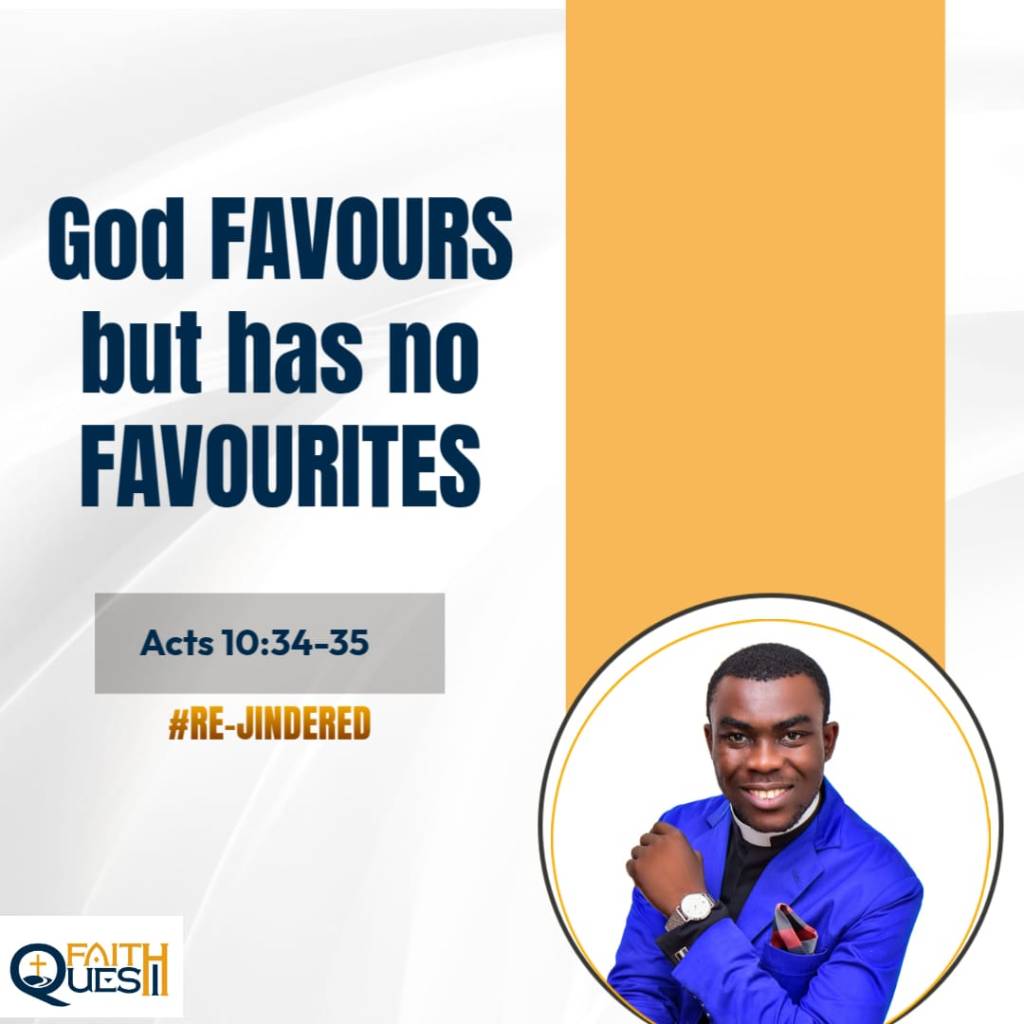
Ultimately, God’s favour is real and available to all. Survival, blessing, or tragedy does not measure his love. It simply intersects with the complexities of human life in a world that operates under both divine providence and natural law. God’s love remains perfect, impartial, and steadfast in every situation. God favours but has no favourites.
[1] Luke 13:1-5 – Jesus addresses the question of whether victims of tragedy are greater sinners, emphasizing repentance over judgment.
[2] 1 Peter 3:14–17; 4:12–19 – Suffering can occur for righteousness’ sake, not necessarily due to sin.
[3] Desiring God. ‘God’s sovereignty does not nullify human responsibility; rather, He ordains all things to fulfill His purposes while respecting our choices.’ desiringgod.org
[4] Romans 8:14 – ‘For all who are led by the Spirit of God are children of God.’
-
-

In the Arena of Love
In the arena of love Some know what they want;others must searchbefore they can choose. Some fall freely,while others are drugged into affection,held by feelingsthey never consented to feel. Some say yesnot out of certainty,but because they never believedthey were worthy of lovein the first place. The saddest lossis not losing love,but losing everyonefor someonewho never…
-

Saturday Sunday
The Lover’s Poem You were born at the opening of time,When the week first learned to breathe—Sunday, soft with promise,They called you Akosua,The one who arrives with grace,The soul that carries gentleness and life. I was born when the week leaned to rest,At the edge of labour and longing—Saturday, steady and reflective,They named me Kwame,The one shaped by purpose…
-
God’s Favour vs. Favouritism: A Theological Reflection
Abstract This article explores the distinction between God’s favour and favouritism, addressing common misconceptions about suffering, blessing, and divine love. Using Luke 13:1-5 as a primary reference, it demonstrates that tragedy does not indicate greater sin, nor does survival indicate greater righteousness. The discussion highlights the impartiality of God, the balance between divine sovereignty and…
-

Whose Child Are You
A Call to Examine our Hearts There was a time when we came to Jesus broken — humbled by our unworthiness and desperate for grace. That brokenness led us to surrender our lives to him. But somewhere along the journey, have we forgotten that posture? If we now believe it is right not to turn…
-

Decency: The Code of Life
Rooted in him, Refined by his Standard It is imperative to acknowledge that our understanding of decency is often biased and incomplete. Many of us do not fully grasp the depth of this word or the profound impact it has on life. Decency goes far beyond outward appearance; it is more than what the physical…
-

For the One I Couldn’t Tell
I once stood close to her light, close enough to feel something real — but fear tied my tongue. Too unsure to say it, too tangled in timing, too afraid of how it might sound. So, silence became my choice. It wasn’t that she lacked beauty. No — she was beauty’s quiet kind, the kind…
-

If God
The Call to Shine If God let it show…If the outward reflected the inward.If our hearts shone as brightly as our mouths claim. God seeks transformation—It begins within,But it cannot stay there. Our faith cannot be hidden.It cannot live only in whispers and testimony.It must be seen.It must be felt. Jesus said, “Let your light…
-

Epicurus and the Problem of Evil: Understanding God’s Goodness and Human Freedom – Part B
Abstract This article explores the problem of evil and its relationship to the existence and nature of God, addressing the Epicurean paradox from a biblical and theological perspective. It argues that the existence of evil does not negate God’s omnipotence, omniscience, or omnibenevolence, but rather reflects the limits of human understanding. Evil is examined as…
-
Without Beauty; Without Majesty
He was despised, but not defeated;Rejected, yet not forgotten. Who will believe what we have heard?To whom does this revelation bring meaning? He became human, a man of suffering,Acquainted with infirmity.Surely he bore our infirmities,Carried our every disease,And was wounded for our sins. But who will believe what we have seen?To whom does this revelation…

Leave a comment